REVIEW · OAXACA CITY
Tour to Monte Alban, Arrazola and San Bartolo
Book on Viator →Operated by Syctravel.com · Bookable on Viator
Monte Albán plus working artisan towns is a strong combo. This 8-hour loop turns one day in Oaxaca City into a mini course on Zapotec, Teotihuacana influence, and today’s crafts—without wasting time. I especially like the chance to start with Monte Albán (2 hours, admission included) and get the big-picture story before you hit the villages.
For me, the best part is the human scale: you’re not just looking at culture, you’re watching it made. The stops in Arrazola for wood-carved alebrijes and San Bartolo Coyotepec for black clay pottery connect the archaeological world to living tradition. One thing to plan for: it’s a long day with meals not included, so you’ll want to budget for lunch and snacks, and wear shoes for walking.
In This Review
- Key highlights you’ll feel fast
- Monte Albán: Start With the Big Power Center of the Zapotecs
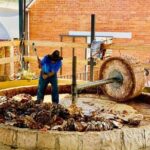
- Arrazola for Alebrijes: Wood-Carving Craft With a Real Family Story
- San Bartolo Coyotepec: The Black Clay Pottery Town Where Craft Is the Daily Life
- Cuilapan de Guerrero’s Ex-Convent and Museum: Oaxaca’s Spanish-Era Anchor
- A Smooth 8-Hour Loop: Pickup, Group Size, and Where Time Goes
- Price and value: What $73.61 Covers (and What It Doesn’t)
- Who should book this tour (and who might skip it)
- Should you book: My decision guide
- FAQ
- How long is the tour?
- Where does the tour start and do you offer pickup?
- Is the tour in English?
- Is Monte Albán admission included?
- Are meals included?
- What happens if the weather is poor?
Key highlights you’ll feel fast
- UNESCO Monte Albán first: 2 hours on the Zapotec power center, with context for what you’re seeing.
- Arrazola alebrijes in a workshop: wood-carving know-how tied to Manuel Jiménez and the Jiménez family line.
- Black clay pottery at San Bartolo Coyotepec: a community where most artisans still practice pre-Hispanic-style craft.
- Cuilapan’s ex-convent focus: a major Oaxaca site tied to evangelization and later Spanish-era development.
- Small group size: up to 14 people, which makes it easier to ask questions and keep the day moving.
- English-speaking guide support: with noted guides such as Eda, Ere, Christian, and a driver like Isaias on some departures.
Monte Albán: Start With the Big Power Center of the Zapotecs

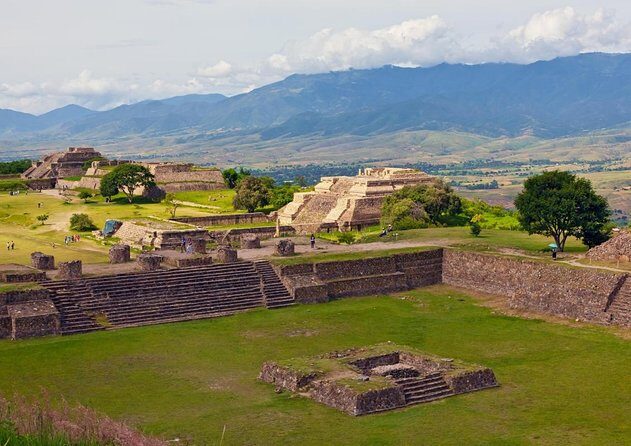
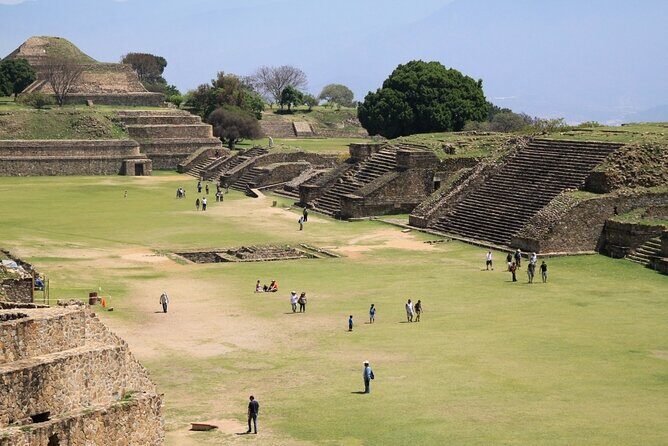
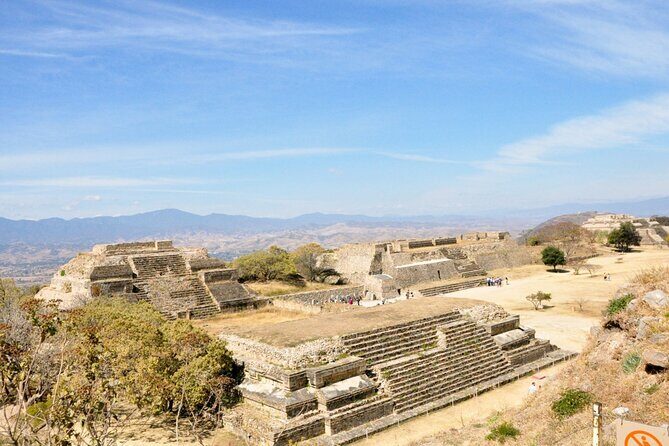
If you only do one archaeological stop on a Oaxaca trip, Monte Albán is a smart bet. It was the large urban center built by the Zapotec culture, and it’s widely treated as the key archaeological area in the state. On this tour, it’s your first stop—because it helps to understand the political and cultural “center” before you see how later communities and trades developed elsewhere.
What I like about the way Monte Albán is framed is that it doesn’t feel like a museum display. You’re given the bigger shifts in time: Teotihuacana influence shows up in architecture, ceramics, and mural painting. Then the link to Teotihuacán breaks, and the Zapotec territorial political organization grows to its highest development—along with social inequality. Later, Monte Albán loses its hegemonic role as Mixtec groups influence the central valleys. A key example is the famous Tomb 7, discovered by Alfonso Caso in 1932, which reflects that changing power story.
You’ll have about 2 hours here, and that’s usually enough to do the main sight circuit without rushing your brain. Still, Monte Albán is outdoors and involves walking on uneven ground. If you’re sensitive to sun, plan for hats and sunscreen. If you’re sensitive to heights or long stairs, go slow early and let your body warm up before you climb.
Practical tip: since admission is included at Monte Albán, you can focus on the visit instead of stopping to sort tickets. And because guides on this kind of day often bring extra anecdotes and humor, you’ll likely get more out of the carvings and tomb names than you would on your own.
If you're still narrowing it down, here are other tours in Oaxaca City we've reviewed.


Arrazola for Alebrijes: Wood-Carving Craft With a Real Family Story
From ruins to workshop energy, Arrazola changes the mood fast. San Antonio Arrazola—often just called Arrazola—is about 10 km off the road to Zaachila. It’s famous for alebrijes, which are fantastical carved figures that people in Oaxaca and beyond recognize instantly.
The tour focus here is not just seeing the finished pieces. It’s understanding the craft tradition behind them. The alebrijes associated with Manuel Jiménez are carved from wood and painted in cheerful, bright colors. Subjects can include jaguars, tigers, mermaids, cats, and nahuales—so even if you don’t care about art theory, you’ll probably care about the characters.
A major plus is that you don’t just browse. You visit the Museum-Workshop of Angelica Jiménez, part of the Jiménez family line (grandson of Don Manuel is mentioned in the background). This is the kind of stop where questions make sense: how the forms are chosen, how the carving is passed down, what tools are used, and what gets refined over generations.
This stop runs about 1 hour, and admission is free for Arrazola on this itinerary. That makes it easy to keep the day’s budget under control. The only caution: because these items are hand-made, prices can vary widely. If you’re thinking about buying, give yourself time to compare a few pieces and don’t feel pressured to decide immediately.
Small win for first-time Oaxaca shoppers: alebrijes are easy souvenirs to carry compared to bigger ceramics or fragile glass. But do check how pieces are packaged before you walk away.
San Bartolo Coyotepec: The Black Clay Pottery Town Where Craft Is the Daily Life
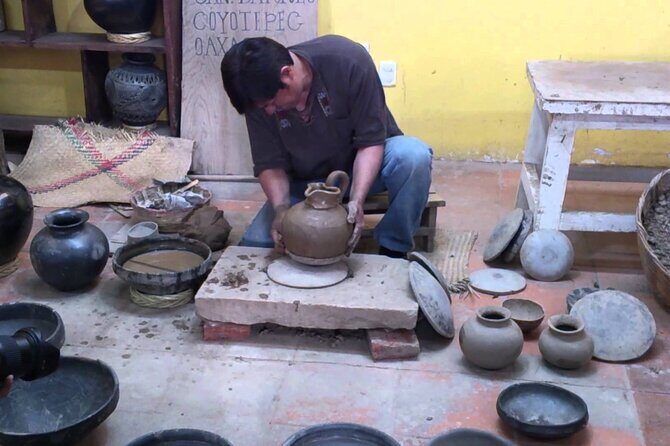
San Bartolo Coyotepec is where the day gets quietly impressive. This town was previously known as Zaapeche, meaning Place of jaguars, and it’s tied to the Zapotec ethnic group of the central valleys. The tone here is different from Monte Albán. Instead of political power and tombs, you’re looking at a community where tradition is the rhythm.
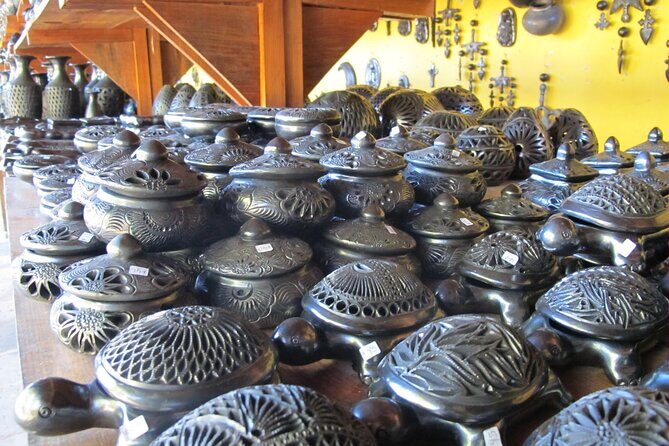
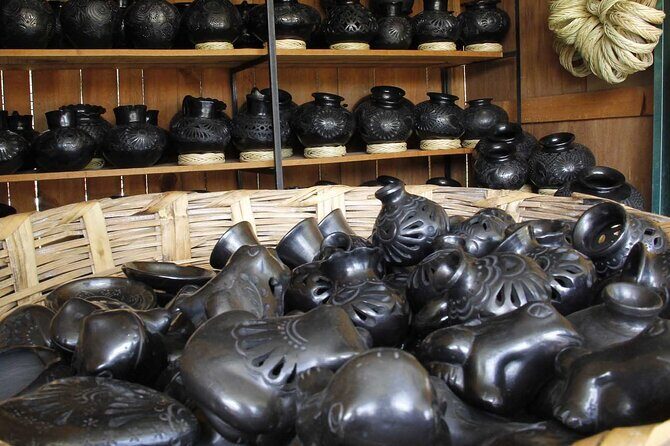
The headline is black clay pottery. This community is described as unique in that a high percentage of its population is dedicated to making black clay pottery—a practice with pre-Hispanic roots. You’ll hear that the craft includes utilitarian pieces (things people actually use) and also pieces made mainly for aesthetic purposes. That mix matters because it shows the tradition isn’t frozen in the past. It serves daily life and it also supports art markets.
The tour also points out the town’s built landmarks. There’s the church dating from the 16th century, plus vestiges of older buildings tied to ceremonial centers or spaces intended for lords. That detail helps you connect “today’s craft” with “yesterday’s social order.”
You’ll have about 1 hour here, and admission is listed as free in the itinerary. If you’re short on time elsewhere in Oaxaca, this is the kind of stop that feels worth the clock because it shows craft continuity rather than one-off demonstrations.
What to consider: black clay pottery can be heavier than you expect. If you buy more than one piece, plan how you’ll transport it back to your lodging. Also, if you’re sensitive to smoke or strong kiln smells, check in with shopkeepers first; the tour data doesn’t promise anything about workshop conditions, so it’s smart to ask.
Cuilapan de Guerrero’s Ex-Convent and Museum: Oaxaca’s Spanish-Era Anchor
After the pottery and artisan energy, Cuilapan de Guerrero brings you back to big structures. It’s located about 10 km from Oaxaca City and sits near several other communities. The name comes from Nahuatl, related to cocoyoles—so the place-name itself hints at the local geography and old languages.
The “Guerrero” part honors Vicente Guerrero, with the note that he was shot in 1831. That’s a reminder that Oaxaca’s story isn’t only pre-Hispanic—it also moves through independence-era history and Spanish colonial development.
Founded in 1551, the story begins with Fray Domingo de Oguinaga. The early evangelizing effort started with a rudimentary temple and a small aqueduct. Those improvements helped Mixtecs and Zapotecs increase in the area, and later the Spanish order granted permits for inhabitants to build what became the current convent.
This tour’s focus is the ex-convent and museum, treated as the main tourist attraction in the community and one of the more important stops in Oaxaca. It lasts about 1 hour.
One practical note for your planning: admission for Cuilapan de Guerrero isn’t listed as included, even though the itinerary text says admission ticket free for the stop. Since the tour’s fee breakdown also mentions Cuilapan admission as not included, I’d treat this like: you may be asked to pay something on site. Bring a little cash or keep a card ready, just in case.
If you like architecture and the way colonial structures grew on earlier cultural ground, this stop scratches that itch. If you’re purely a ruins person, you may find yourself wishing Monte Albán had a little more time. Still, it balances the day nicely by showing how Oaxaca’s built environment shifted over centuries.
A Smooth 8-Hour Loop: Pickup, Group Size, and Where Time Goes

This tour is built for a full day without feeling frantic. You start at 9:00 am, and pickup is offered. If your hotel isn’t on the standard pickup list, you provide your full address so the provider can arrange service.
One of the better details for comfort is the air-conditioned vehicle. That matters in Oaxaca because the sun can turn “a short walk” into a workout. The tour also caps at 14 travelers, which keeps it in the small-group category. For many people, that’s the difference between feeling like a number and actually having time to ask a question.
The structure is straightforward:
- Monte Albán first (big outdoor site, 2 hours)
- Arrazola next (workshop feel, 1 hour)
- San Bartolo Coyotepec after (craft community, 1 hour)
- Cuilapan de Guerrero last (convent and museum area, 1 hour)
In real life, you’ll lose some time to driving and transitions, so expect the day to feel active even if each stop isn’t all-day. Meals and drinks aren’t included, but this kind of itinerary often includes a lunch break you can use. The positive note from guide-led days like this is that the lunch stop tends to be reasonably priced and full of traditional dishes, so you can eat like you’re in Oaxaca instead of settling for something generic—just remember you’re paying out of pocket for food.
Also worth knowing: the tour uses a mobile ticket, so you’ll want your phone charged and ready. Traveler’s insurance is included, and tipping isn’t included—so plan to tip your guide or driver if you feel they did a great job.






Price and value: What $73.61 Covers (and What It Doesn’t)
At $73.61 per person for roughly 8 hours, the value comes from three areas: the UNESCO admission at Monte Albán, transportation, and the fact that you’re seeing multiple different kinds of Oaxaca culture in one shot.
Here’s the practical breakdown:
- Included: air-conditioned vehicle, all fees and taxes (as listed), and traveler’s insurance.
- Included in the itinerary: Monte Albán admission ticket is included.
- Not included: tips, food and drinks, and admission in Cuilapan de Guerrero (listed as not included).
So you’re paying mostly for access and logistics, not for meals. That’s actually good value if you like choosing your own lunch spot or you want to control dietary needs.
If you’re comparing to hiring private transport, this is usually a lower-cost way to cover distance. If you’re comparing to DIY, it’s a bargain when you consider that the tour puts archaeology, living craft, and Spanish-era architecture into a single timed plan with English guide interpretation.
What you should do to keep the value high: plan a modest souvenir budget for alebrijes and pottery. These are the kinds of crafts that are hard to resist, and you’ll likely see work from specific makers like the Jiménez family. Buying small can be easier than buying big here.
Who should book this tour (and who might skip it)
This tour is a great fit if you:
- Want one organized day outside Oaxaca City that still feels real, not staged
- Like understanding context—Monte Albán isn’t just ruins, it’s a story of shifting influences
- Prefer artisan stops where the craft is tied to families and daily practice
- Travel with a group that appreciates both archaeology and handmade work
You might skip (or at least adjust expectations) if you:
- Only want long archaeological time and prefer fewer stops
- Hate walking in the sun or want a more relaxed pace
- Don’t want to think about any possible extra admission at Cuilapan de Guerrero
One more tip: because the tour requires good weather, don’t treat it like a last-minute gamble. If the forecast turns ugly, you’ll want backup options in your schedule.
Should you book: My decision guide
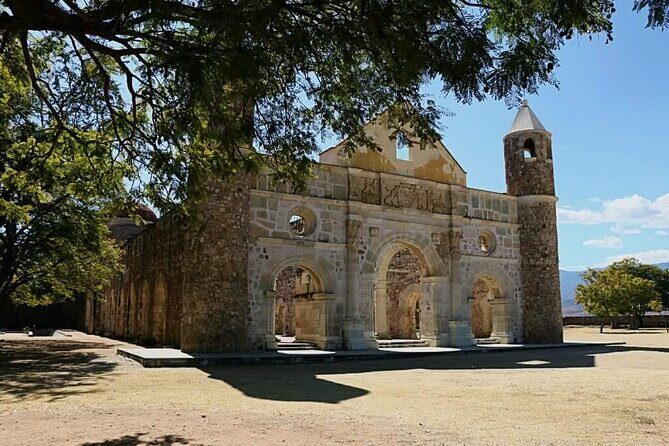
If you’re trying to understand Oaxaca as more than a pretty city, this itinerary does the job. You get a UNESCO-level starting point at Monte Albán, then you move into living crafts: alebrijes in Arrazola and black clay pottery in San Bartolo Coyotepec. Cuilapan de Guerrero adds a strong architectural finish that ties the region’s story into colonial-era development.
I’d book it if you want value and structure. The small group size helps, and the guide experience seems to matter a lot on these days—names like Eda, Ere, and Christian have been highlighted for making explanations clear and fun, with drivers like Isaias mentioned for a safe, steady ride.
Before you go, do two simple things:
- Bring cash/card for any possible Cuilapan admission and for lunch
- Wear comfortable shoes and plan for sun
If that sounds like your kind of day, you’ll likely feel like you used your time well.
FAQ
How long is the tour?
It’s about 8 hours.
Where does the tour start and do you offer pickup?
The start time is 9:00 am, and pickup is offered if your hotel is on the pickup list. If not, you’ll need to provide your full address.
Is the tour in English?
Yes, it’s offered in English.
Is Monte Albán admission included?
Yes, admission for Monte Albán is included, and the stop lasts about 2 hours.
Are meals included?
No. Food and drinks are not included.
What happens if the weather is poor?
The experience requires good weather. If it’s canceled due to poor weather, you’ll be offered a different date or a full refund.